Saturday, May 14, 2011

Another James Spence Mistake!


1948 Leaf Card of Jack Johnson Authenticated by James Spence


Has anyone seen the latest item for sale in American Memorabilia’s Auction? This outfit who has a long history of selling items mis-authenticated by 3rd party authenticators has what they describe as a “1948 Leaf - Jack Johnson Signed card #17”. Opening bid $200.00.

A genuine signature of Jack Johnson is quite uncommon. According to several genuine autograph experts, the signature on this card is a very poor quality forgery and no respected authenticator would ever attach their name to it. Yet, this poor quality forgery passes muster by James Spence. This item has been authenticated as genuine by James Spence at JSA Authentication.

Once again, how could this happen? How in the world was any research done on this signature by James Spence to pass this horrible forgery as genuine? Again, we ask James Spence to come forward and tell us what he did to determine this signature of Jack Johnson is genuine? What did he do time wise for the money he was paid to authenticate this item? Where in the world did he find even one exemplar to make such a horrible guess? What credentials does James Spence have to be an autograph authenticator?

No matter what James Spence has to say to even attempt to justify his latest blunder, may we also state that Jack Johnson died on June 10, 1946, two years before this card was produced!

The following is an email we received recently. It is like so many others we have received.
5/11/2011 1:44:23 Eastern Daylight Time
“I also want to mention to support your story on JSA. I was given a ball hand signed by Albert Pujols, he actually put the ball in my hand. JSA (James Spence) was having an event in Feb with Steiner Sports. I decided to take the ball over to them JUST to see what they would say. Of course, they asked “where I got the ball” prior to actually looking at it. I responded, “what difference does it make where I got it“? They failed the ball, at which point I then told them where I got the ball. And of course they did not believe me and said it was a fake. Worst of all they still charged me the 430. Thanks much, John W.”

Monday, February 21, 2011

James Spence Authentication: Authenticating Memorabilia or Pushing An Agenda? JSA Fails Pieces They Already Certified As Authentic!

We have heard people in the autograph and memorabilia collecting community say that James Spence Authentication (JSA) will fail anything that has previously been certified by any other forensic examiner.

We decided to put this assertion to the test, with an unusual twist. We had several pieces certified by JSA. We then had them certified by Christopher L. Morales, Forensic Document Examiner (Chris Morales). What would JSA do with the pieces that already had JSA certifications after they also had certifications from Chris Morales? Would JSA really fail pieces it had already certified?

Look at the results and you can decide for yourself what a JSA examination really amounts to.

The first item is a pair of boxing trunks signed by Joe Frazier (detail below).


The piece comes with a JSA sticker affixed to it, W54017. It states that Joe Frazier signed the piece in front of a JSA staff member. It is part of their "Witnessed Protection Program," the highest guarantee JSA can give (below is the certification).


We showed the same piece to JSA again after it had been certified by Chris Morales. The only difference is now it has a hologram and certificate from Chris Morales (see below).


As seen, it is the same pair of boxing trunks. It has the same signature. What did JSA do with the piece?


That's right, they failed it. JSA gave eight reasons to explain the flaws in the JSA "Witnessed Protection Program" piece of memorabilia. Apparently, the mere presence of Chris Morales' certification has caused the JSA "Witnessed Protection Program" to grow atypical letter slant, angle and/or pitch. Did this problem occur when the JSA staff member witnessed the piece or afterwards?

Not only did JSA fail the piece, but Larry Studebaker, James Spence's main authenticator, laughed out loud and said the piece was "f-ing horrible." Really? A piece from JSA's "Witnessed Protection Program"?

According to Larry Studebaker, James Spence himself personally checks all of the items before he issued a JSA certificate. James Spence did not overrule Larry Studebaker. According to JSA, their previously witnessed piece is now a forgery.

Did the irregular letter shape and/or formation occur when Joe Frazier signed the piece in front of the JSA staff member? Did it occur after JSA put its identifying sticker on the boxing trunks? Did it occur after Chris Morales certified it?

Just what does the "guaranteed to be authentic" on the original JSA certificate mean if JSA fails its own witnessed piece? How could this happen? Would it happen again?

The next piece is a Mickey Mantle jersey (below). Accompanied by a full JSA Letter of Authentication, it has JSA sticker number B35319.


Same test. Would we get the same results? Would JSA fail an item JSA had previously passed if Chris Morales passed it?
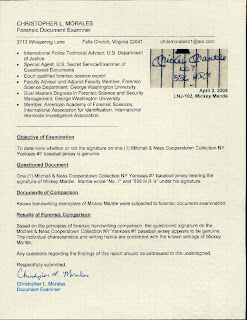


The answer is yes!!


This time, JSA found twelve reasons to fail the Mickey Mantle baseball jersey that had already been certified by JSA. Apparently, now the signature suffered from such problems as "Drawn slowly, Labored & contrived," "Hesitation, tremors, patching, and/or pen lifts" and "Unusually positioned on item."

When did these problems, and the other problems, creep into the signature? Before or after JSA issued its first certificate? After Chris Morales certified it? How did that change the signature?

It certainly seems that JSA was examining Chris Morales' certificate more than the Mickey Mantle jersey the second time JSA looked at the same piece JSA had already certified as genuine. How is that a legitimate business act? Shouldn't JSA actually be judging the signature instead of any other certificates? Is this fair to their customers?

Apparently, now that Chris Morales had certified the jersey, Larry Studebaker feels the signature "isn't even close."

Once again, when James Spence personally checked the item before he issued a certificate, he did not overrule Larry Studebaker. According to JSA, their previously certified piece is now a forgery.

Surely, JSA would not do it again, right? Surely JSA would base its reports on the merits of the memorabilia.

Wrong.

The next piece is a Paul McCartney World Tour booklet. Signed boldly by McCartney on the cover, it is accompanied by the full JSA Letter of Authentication, and has JSA sticker number B34513.


Once again, Chris Morales examined it, concurred with the initial JSA findings, and issued a certificate of authenticity.


Would that solitary piece of paper be enough to make sure JSA would no longer have faith in the piece, even though nothing has been done to the signature? The answer again, is yes.


Apparently, failing items certified by Chris Morales is more important than the validity of memorabilia, even if the same piece has previously been certified by JSA.

This time, there were twelve problems with the piece. Apparently, at some time between the first JSA certificate and Chris Morales' certificate, the booklet developed, among other things, "Irregular letter slant, angle and/or pitch," "Excessive pen pressure and/or improper shading," "Sizing of letters Disproportionate/Exaggerated/Undersized," and "Irregular letter shape and/or formation".

According to the JSA examiner, he had personally obtained several signatures of Paul McCartney, and the signature on the booklet was "nothing like Paul McCartney's signature. Chris Morales will pass anything."

Didn't the twelve issues that JSA observed after Chris Morales certified the booklet bother JSA when it originally certified the piece as genuine?

Once again, when James Spence personally checked the item before he issued a certificate, he stated that their previously certified piece is now a forgery.

In JSA's original certificate reported that the signature on the booklet was consistent with JSA's "extensive database of known exemplars." Ironically, the JSA certificate passing the very item before Chris Morales certified it stated "The signature is consistent considering a wide range of specific qualities, including slant, flow, pen pressure, letter size and formation, and other characteristics typical of our extensive database of known exemplars we have examined throughout our hobby and professional careers".

Four of the very reasons JSA used to praise the booklet when JSA originally passed it became reasons 1, 4, 6 and 12 when Chris Morales' certificate seems to have caused JSA to fail the same piece.

Apparently, the problem is not limited to JSA's "Witnessed Protection Program" and their full letters of authenticity, but their "Basic Cert" authentications, as well.


According to the JSA website, the only difference between the full certificate and the Basic Cert is the price. "Popular among dealers and collectors alike, the Basic Cert employs the same valued authentication process to verify lesser valued autographed items. Included with the Basic Cert program is a 3" x 5" James Spence Authentication registration card printed with a unique certification number corresponding to the alpha-numeric tamper evident label. Of course, similar to the Premium Letter of Authenticity each certification number is uploaded into our exclusive database for 24-hour customer verification access. All Basic Cert cards are fully transferable without resubmission."

Unfortunately, if Chris Morales sees the piece, the "fully transferable" concept goes right out the window.


It certainly seems that JSA is likely to fail any piece that is attached to Chris Morales' certificate.


The same seemed to be true of witnessed pieces.


Chris Morales certified this Upper Deck certified, witnessed piece. Tiger Woods signed the piece in front of Upper Deck's certified witness program.


Unfortunately, if JSA gets the chance to turn down the Chris Morales certified piece, which is a clean, textbook example of Tiger Woods' signature, JSA makes the most of the opportunity.


JSA even went so far as to list "C. Morales 7-18-08" as the type in the descriptor box.

JSA listed twelve reasons for failing the Upper Deck witnessed piece. In fact, when the piece was examined, the JSA representative picked up Chris Morales' certificate and stated "it's amazing what this guy gets away with."

Even worse, on JSA's own website, it lists "Valued auction houses and dealers employing our services include"…you guessed it: Upper Deck. JSA failed his own client's piece when it showed up with a Chris Morales certificate.

JSA proved consistent with another Upper Deck witnessed pieces. JSA's client's witnessed pieces.


Chris Morales certified the piece (below).


Despite Upper Deck's guaranteed "5-step patented hologram process," a Chris Morales certificate seems to doom practically anything JSA sees.


Other witnessed pieces did not fare any better, like the below Bret Michaels signed guitar.


Chris Morales certified the piece as authentic.


One of our associates made an appointment with JSA in a hotel conference room after one of their trade shows. There were several clients there, all getting individualized attention from JSA.

An individual who Larry Studebaker told our associate was a "regular client" also had a Bret Michaels signed piece. Studebaker told our associate he was not comfortable with the guitar. Larry Studebaker pointed out that the "regular client's" piece looked "completely different" than our associate's, so obviously his was a forgery and the regular client had a genuine piece, which JSA certified as genuine.

The problem?


We know Bret Michaels of the group Poison signed and personalized our associate's guitar. You can even see the inscription in the photo. If the "regular client" had a piece that looked completely different from our associate's, and we have pictures of Bret Michaels signing and posing with ours, shouldn't the piece that looks completely different from the guitar be the one JSA failed?

Apparently, JSA did not think so. As a matter of fact, when you look at the following JSA report, in the descriptive box, JSA even referred to Chris Morales’ report in the text describing the type of guitar. What was JSA examining, the signature or Chris Morales’ certificate?

Incidentally, JSA also criticized, among the other issues, the fact that the “Ink doesn’t have characteristics normally found with naturally aged ink”. This is quite a perplexing criticism, when one considers the fact that Bret Michaels is still alive and, theoretically, could have signed the guitar the very day that JSA looked at it. How is ink currently on the market used by living people – possibly really recently - supposed to age?


Interestingly enough, our associate witnessed some disturbing behavior during his visit with JSA. Another of the "regular" clients came with a stack of 40-50 photos. Larry Studebaker had the photos in a pile on his table. They were upside down. The photo side with the signature was on the bottom. While Larry Studebaker chatted with the regular client, he placed a JSA on the back of each photo - without even turning them over - and passed them on to his associate to process. He did not even look at any of the photos, but they were all certified by JSA.

Apparently, being a "regular customer" of JSA has its perks.

One afternoon, James Spence had the opportunity to show whether or not his practices detailed throughout the story above were an anomaly or standard JSA operating procedures.

James Spence sat down with a collector and briefly looked through a collection of baseballs. Prior to his examination, he was informed that all of the baseballs had been certified by Chris Morales.

You guess right. Everything failed.

Were the baseballs bad?

One of the three photos below is of JSA certified baseball B91695. One of the baseballs below is of JSA certified baseball B81823. The other baseball was one of the baseballs that James Spence said was a forgery, after he had been informed that Chris Morales had certified it.


They are in no particular order. We defy you to figure out which one is the "forged" baseball. To make this more like a pop quiz, we have removed the photo of the "forged" baseball from JSA's report. Can you tell which one is the failed ball? Can anyone justify that one of these was written by anyone other than the signer of the other two?


James Spence told the collector that everything he had were "fakes and frauds." He further told him that he should get his money back ASAP.

At the very least, the preceding test cases question the company's ability to carry out the service of authentication. In each of the above test cases it was found JSA failed the same pieces that they had already certified as authentic. It certainly lends credence to the assertion the company will fail anything that has previously been certified by any other forensic examiner. This includes a piece, the Joe Frazier trunks, that was signed in front of them.

What then is a JSA certification worth if their own authentication standards are disingenuous, capricious, and arbitrary?

Considering the work that James Spence and his staffers do, and their apparent combined bias and indifference to the genuineness of the memorabilia they are charging customers to examine, there is a problem with "fakes and frauds." If James Spence and his staffers want to determine where the source of such "fakes and frauds" are, they might want to start by looking in a mirror. In closing I am not a real big Chris Morales fan but the customer has the right to have the signature examined. When JSA tells a customer or client that an autograph is not authentic, they trust that it has been examined. As you can see that's not the case, in fact it's just plain dishonest.

Monday, January 31, 2011

Beware of the questionable selling tactics on ebay!


I just found the following words on an ebay autograph auction:
"This item is sold "AS IS" AND NO RETURNS WILL BE ACCEPTED."
What ????

Only ebay sellers advertise autographs this way. Who would possibly buy something from an autograph seller when he says that in his ad. I don't call them autograph dealers, they are just autograph sellers. A dealer is someone who has some knowledge of autographs, a seller is someone who is not a dealer. I have never seen a real autograph dealer trying to sell in this way. Why do you think this seller won't accept returns? The answer is painfully obvious, basically this is what they are saying: "I am not sure if this is authentic but if you buy it you are stuck with it."
The legitimate autograph community would never operate in this way. There are a number of autograph sellers on ebay who do not accept returns. Be very hesitant about buying from them.

I have also found another ebay autograph seller who has his auctions set up in a way that allows him to not answer questions from other ebay members. What does that tell you about his autographs?

Monday, December 6, 2010

More PSA/DNA Mistakes! When will it end?

The First Item is a Correctly assessed in Travis' opinion while the 2nd one is an incorrectly "stickerd" Chavez that ought to be Chuvalo.

Both items have stickers that are only 87 items apart, the good Chuvalo is K67412 and the Chuvalo they called a Julio Chavez is k67499.


Below is the following incorrectly PSA/DNA certified signature of Julio Chavez, when it is a George Chuvalo as provided by Mark Ogren, in his opinion; "PSA" thinks heavyweight contender George Chuvalo is Julio Cesar Chavez (K67499). Was this even a close miss? I guess I can see a "J", "C" and "Z" in there somewhere?"


So if you own the 1st one you are ok, but if you own the 2nd one and/or are about to buy it - u could have an issue.

The verification information from PSA/DNA reads as follows;
Item: Cut
Primary Subject: JULIO CESAR CHAVEZ
Authentication Date: 09/28/2010
Result/Grade: Authentic


Here is an Ali signed boxing glove authenticated by Bob Eaton and Bill White at RR Auction, and James Bruce at Signature Arts. We then sent the scan along to PSA for an unbiased opinion. What do you think? Well there opinion was that is was not genuine. It's obvious that the mistakes that PSA/DNA are making are becoming more and more frequent. Are they getting to big and to busy to actually evaluate items thoroughly? Every day we are getting emails and phone calls about PSA/DNA mistakes.
When will it end?

Thursday, November 18, 2010

“The Father of Baseball”


Who is “The Father of Baseball”? The answer is very controversial!

In 1895 upon the death of Harry Wright, Henry Chadwick commented that Wright was virtually the founder of professional base ball.

In 1904, Theodore Roosevelt presented the title of “Father of Baseball” to British born Henry Chadwick who is the only sportswriter enshrined in the Baseball Hall of Fame.

In 1905 the Mills Commission was formed by Albert Spalding. It consisted of many major base ball executives including:

Abraham Mills, National League President
Morgan Buckeley, National League’s First President
Arthur Gorman, ex-president of Washington Base Ball Club
Nicholas Young, Fifth President of the National League
A.J. Reach, former Philadelphia Athletics player
George Wright, former player 1869 Cincinnati Red Jackets
James Sullivan, President of the Amateur Athletic Union.

These men issued their final report on December 30, 1907 and declared that their final decision was Abner Doubleday “invented” baseball.

Alexander J. Cartwright was inducted into the Base Ball Hall of Fame in 1938 and enshrined in 1939. His Base Ball Hall of Fame plaque reads that he is “The Father of Modern Baseball.”

Harry Wright comes back into the picture when Christopher Devine’s 2002 book is published with the title Harry Wright The Father of Professional Baseball.

Ron Keurajian who is accepted by most as the leading autograph expert on Baseball Hall of Fame autographs. One expert in the field recently stated that if you put all the so called self-proclaimed autograph authenticating experts who are on the staff of authenticating companies they wouldn’t add up to a pimple on Keurajian’s derriere.

Keurajian is working on the finishing touches of his massive book on Baseball Hall of Famers. He recently wrote a letter to Bud Selig who is the ninth Commissioner of Baseball and he has held that position since 1998. Keurajian asked Selig who he thought was the “Father of Baseball.” Selig’s response stated he believed that Abner Doubleday is “the Father of Baseball.”

Enter into the picture someone by the name of Keith Olberman. Many we have spoken to were unaware of who Keith Olbermann is. A quick check on Google states that he is an American News Anchor, sportwriter and political commentator. One article states he was fired by MSNBC another states he has been suspended by NBC.

On Olbermann’s blog he now becomes an autograph authenticator. He states: “There is a chance that’s not actually a letter from him (Selig)……so who knows, maybe this is a faked Selig letter.”

Signature Arts, Inc. and James Bruce was asked to comment on Olbermann’s statement and we had our genuine well documented autograph experts examine the Keurajian, Bud Selig letter. Every one has stated, without a doubt, the letter from Bud Selig is genuine and has been hand signed by the Commissioner.

Thursday, November 4, 2010

It seems the Auction House formerly called Mastro is in trouble again!!


Here is an interesting story from the New York Daily News detailing the latest problems for the former Mastro Auctions. Written by Michael O' Keeffe. Will this kind of stuff ever end?

"Bombshell court documents filed by the president of a New Jersey card-grading firm say the company formerly known as Mastro Auctions knowingly sold him an altered baseball card and placed fake bids on items to artificially jack up prices. The counterclaim and third-party complaint filed late Wednesday in Illinois state court by Dave Forman of SportsCard Guaranty also says that former Mastro president Doug Allen sold a Joe Jackson T210 card for Forman in September 2009 to New York collector Corey Shanus for $300,000. But Allen told Forman that the card only sold for $250,000 - and then pocketed $50,000, the documents say. Allen's spokeswoman, Julie Stoklosa, disputed the allegation, saying that Forman told Mastro Auctions that he would sell the card for $250,000. Mastro officials kept the additional $50,000 as their fee for finding a buyer. "This is just another example of their fraud," countered Jeffrey Lichtman, one of Forman's attorneys. "It was flat-out thievery." Forman's filing offers a glimpse into the Justice Department's three-year investigation into Mastro Auctions and its founder, Bill Mastro, which has focused on allegations of shill bidding, card doctoring and other fraud. One of the former Mastro employees cited in the complaint, Pete Calderon, testified before the grand jury that has been reviewing evidence gathered during the government's third major sports memorabilia probe in 15 years, according to a source familiar with the investigation. Other witnesses who have appeared before the grand jury have testified about allegations included in the documents, the source said. Forman says Allen told him in 2007 that he wasn't worried about the investigation because Mastro officials had destroyed all bidding records prior to 2007 "that would expose its fraud." Shill bidding was an open secret at Mastro Auctions, according to the complaint. "In May 2006, Forman overheard Mastro on the telephone with a collector named Chris Larson. Forman overheard Mastro discuss that Larson wanted to buy a L-1 leather Ty Cobb item and was willing to pay up to $41,000 for it," the counterclaim says. "Forman had been keeping an eye on that item during the auction, which was bidding for $17,000.00 at the time of Mastro's conversation with Larson. However, several minutes later, the item was bidding at $41,000 and Forman believes that this was a result of the entry of fake bids by Ketap employees." The court documents, and a motion for protective order that was also filed on Wednesday, say Mastro Auctions controller Walter Tomala violated Illinois and federal laws by making 34 harassing phone calls in 46 minutes to Forman's home between 1:58 a.m. and 2:44 a.m. on Sept. 10. "I'm going to bring you down - one way or another, I'm gonna bring you down, because you are a piece of --- and your brother's a retard, so I will bring you down," Tomala, who first identified himself as "Bill Mastro," allegedly said in a message left on Forman's home voicemail. Tomala sent an email to one of Forman's attorneys to apologize for the phone calls shortly after the incident. "I had a bad day yesterday and I unfortunately took it out on Mr. Forman," Tomala's email said. Attorneys representing Mastro and Allen did not return calls for comment. Mastro Auctions was once sports memorabilia's biggest and most important auction house, reporting $45 million in revenue in 2006 and 2007. The company specialized in rare and expensive collectibles, catering to wealthy collectors who don't blink at the prospect of spending $100,000 or more for a baseball card. Bill Mastro was sports memorabilia's undisputed king, hailed in the media as the nation's top memorabilia dealer. But the Chicago-area auction house, now known as Ketap Company, shut its doors in March 2009, several months after the Daily News first reported that Mastro Auctions and its executives were at the center of an FBI investigation into shill bidding, card doctoring and other allegations of fraud. Allen and other former Mastro executives purchased Mastro Auction's assets and launched a new company called Legendary Auctions. Allen and his partners vowed that all Mastro Auctions business will be "seamlessly facilitated, processed and completed through Legendary Auctions," but many consigners complained they had been stiffed by the company. Allen told The News last year that Mastro Auctions was struggling with cash-flow problems because some bidders had not paid their bills. The company filed a lawsuit in June 2009 alleging that Forman owes Mastro more than $400,000 for items purchased n 2007 and 2008 auctions. Forman's counterclaim says Mastro Auctions failed to credit almost $22,000 to his account from the sale of baseball cards and comic books the auction house sold on his behalf in 2008 and 2009; the company also owes almost $157,000 for vintage baseball cards Forman consigned for auction but were never sold or returned. The counterclaim also says Forman purchased a 1913 T200 card in 2008 for $13,200. Forman later learned that when Mastro had sold the card in 2004 for almost $3,900, the catalogue noted that it had been altered - a fact that had been omitted from the 2008 catalogue. Doctored cards are generally worth much less than cards that have not been altered. "Mastro instructed Pete Calderon, a Ketap employee, to change the description for the Joe Jackson Fatima by omitting the material fact that it had been rebacked prior to the May 1, 2008 auction," the complaint says. "The rebacking of the Joe Jackson Fatima significantly devalued the card." According to the documents, Mastro officials also used the names of several associates - including Andrew Filipowski, the entrepreneur whose private investment firm purchased the auction house in 2005 - to create accounts for shill bids to artificially escalate prices and auction house commissions."

For the sake of accuracy it should be stated by me that Mr Forman's attorney is an acquaintance of mine. He is a vital member of Net54 the leading website forum on the internet to discuss collecting.

Thursday, October 14, 2010

Roy Rogers Museum Auction Museum Closed in 2009, Collection sells for $2.9 Million Roy Rogers' stuffed horse Trigger and His Saddle are top sellers!


The stuffed horse belonging to cowboy actor and singer Roy Rogers along with his saddle took top dollar at an auction in July for memorabilia from the Roy Rogers and Dale Evans Museum Collection.

The Museum closed in December 2009, less than six years after it picked up and moved from its longtime Route 66 home in Victorville, California, to Branson, Missouri.

Christie's auction house, which ran the sale along with Western auctioneer High Noon Americana, said the collection of items related to Rogers' and wife Dale Evan's roles on television and in the movies brought in $2.9 million.

Trigger, the palomino horse which Rogers had stuffed after it died in 1965, was bought by rural cable television station RFD-TV for $266,500, while his saddle fetched $386,500 from a private buyer.

Other top sellers included Roy Rogers' 1963 Pontiac Bonneville and the Nellybelle jeep, an iconic emblem on the Roy Rogers Show, which ran on television in the 1950s and 1960s.

The more than 300 items included in the sale ran from Roy's sunglasses to a sterling belt buckle and a Roy Rogers directors chair. Here is a partial listing of some of the items that were sold at auction:

Roy 's 1964 Bonneville sold for $254,500, it was estimated to sell between 100 and 150 thousand dollars.

His script book from the January 14,1953 episode of This Is Your Life sold for $10,000 (est. $800-$1,000)

A collection of signed baseballs (Pete Rose, Duke Snyder and other greats) sold for $3,750

A collection of signed bats (Yogi Berra, Enos Slaughter, Bob Feller, and others) sold for $2,750.

One of many of Roy 's shirts sold for $16,250 and one of his many cowboy hats sold for $17,500.

One set of boot spurs sold for $10,625. (He never used a set of spurs on Trigger.)

A life size shooting gallery sold for $27,500.

Various chandeliers sold from $6,875 to $20,000. Very unique and artistic in their western style.

A signed photograph by Don Larsen taken during his perfect game in the world series against
the Dodgers on Oct.8, 1953, along with a signed baseball to Roy from Don, sold for $2,500

Two fabulous limited edition BB guns in their original boxes with numerous photos of Roy,
Dale, Gabby, and Pat sold for $3,750.

A collection of memorabilia from his shows entertaining the troops in Vietnam sold for $938.
His flight jacket sold for $7,500.

His set of dinner ware plates and silverware sold for $11,875.

The Bible they used at the dinner table every night sold for $8,750.

One of several of his guitars sold for $27,500.

Nellybelle sold for $116,500.

A fabulous painting of Roy, Dale, Pat, Buttermilk, Trigger, and Bullet sold for $10,625.

One of several sets of movie posters sold for $18,750.

A black and white photograph of Gene Autry with a touching inscription
from Gene to Roy sold for $17,500.

A Republic Productions Poster bearing many autographs of the people that played in Roy's movies sold for $11,875.

Dale's horse, Buttermilk (whose history is very interesting) sold below the pre-sale estimate for $25,000. (est. 30-40K)

Bullet sold for $35,000 (est. 10-15K). He was their real pet.

Dale's parade saddle, estimated to sell between 20-30K, sold for $104,500.

One of many pairs of Roy's boots sold for $21,250.


It's no wonder Trigger fetched over $266,000 at the auction. He was a genuine Hollywood star. Roy and Trigger made 188 movies together. The horse began it's "career" in show biz in the 1930s. Do you remember the 1938 movie The Adventures of Robin Hood with Errol Flynn and Olivia de Havilland? Well Olivia rode Trigger in that movie.

Trigger was bred on a farm co-owned by Bing Crosby. Roy bought Trigger on a time payment plan for $2,500. Trigger even out did Bob Hope by winning a P.A.T.S.Y. award (animal equivalent of the Oscar) for the movie Son of Paleface, in 1953.